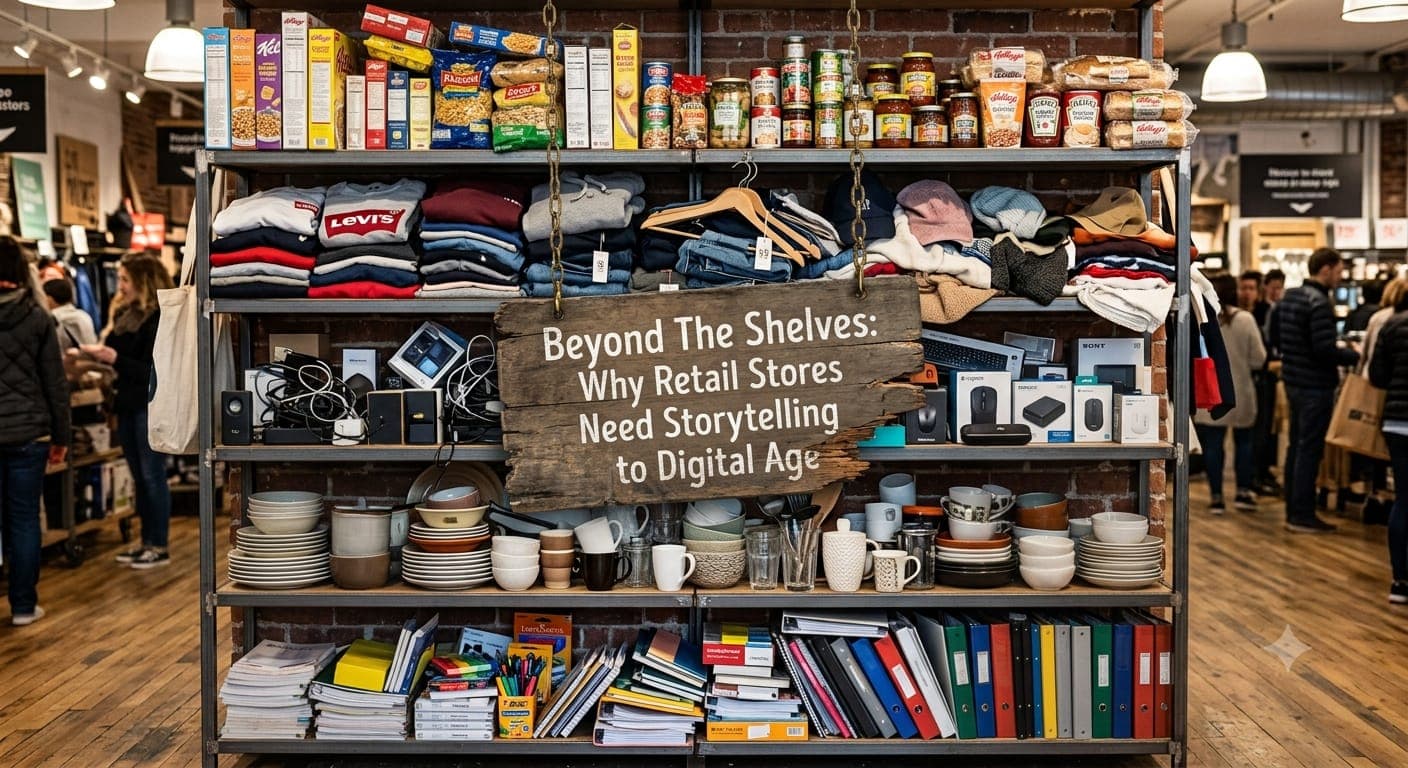
Against the relentless speed of algorithms and the flat gloss of glass screens, the high street holds an unmatched card: the ability to engage all five senses. Yet, what turns a physical shop from a quiet warehouse into a living space is the narrative woven into its walls.
Storytelling in retail is not a decorative flourish or a clever marketing slogan. It is a measurable business strategy that directly shapes dwell time, customer loyalty and commercial resilience.
A 2,706 Per Cent Surge in Value: People Buy Meaning, Not Commodities
What transforms a ceramic mug, a woollen throw or a wooden tabletop from a simple utility into an object of desire? The notable Significant Objects experiment, led by Rob Walker and Joshua Glenn, answered this with remarkable precision.
The researchers bought 100 ordinary, unwanted items from thrift shops and car boot sales for an average of 1.25 dollars each. These were insignificant trinkets, worn hotel keys and chipped figurines. Writers were then invited to craft short, heartfelt stories for every piece. When listed on eBay accompanied purely by these literary narratives, the collection, which originally cost 128 dollars, sold for a staggering 3,612 dollars. The storytelling alone generated an overall value increase of 2,706 per cent.
When you reveal the provenance of a piece, the hands of the maker or the landscape where an idea was born, price comparisons dissolve. Curiosity replaces scepticism, and the willingness to invest deepens.
The Power of Dwell Time: Why Lingering Matters More Than Footfall
For decades, retail performance fixated on raw footfall numbers. Modern spatial analytics show that footfall tells only half the story.
According to data from Ariadne Maps, revenue per visit correlates strongly with in store dwell time at r = 0.71, whereas the correlation between entry count and revenue sits at just r = 0.43. Busy tills are not driven by hurried crowds marching past shelves; they are filled by people who feel invited to slow down, explore and stay.
A thoughtful narrative turns a routine errand into a journey of discovery. The gentle scent welcoming you at the door, an open workshop corner around the bend, or tactile raw materials all encourage customers to linger. Research from McKinsey confirms that experiential, narrative led retail concepts consistently deliver an uplift of 2 to 7 per cent in top line sales.
Forgotten Specifications, Remembered Feelings
Human memory quickly sheds lists of bullet points and technical specifications, yet it readily holds onto stories.
- Retention
- Findings published in the Journal of Consumer Psychology show that whilst isolated facts have a 72 hour recall rate of only 6 per cent, information embedded within a narrative achieves a 68 per cent retention rate.
- Mental Salience
- Kantar BrandZ data indicates that story led communications leave a memory imprint 25 times more durable than conventional feature lists.
- Return on Investment
- An analysis of over 1,400 commercial campaigns by the UK's IPA Databank revealed that emotionally resonant, narrative driven campaigns generate 51 per cent higher profit gains than purely rational, feature led strategies.
From Shelving Displays to Atmospheric Scenography
Bringing narrative into a physical store does not mean pasting clever aphorisms on the walls. Storytelling is the quiet architecture felt in every step:
- The Threshold
- Design an entrance that filters out street noise, encouraging people to take a breath and match the pace of the space.
- Staff as Story Guides
- Teams on the shop floor should not merely scan barcodes. They are the narrators of the work. Shopify Plus metrics demonstrate that placing the story at the centre of product presentation increases conversion rates by up to 34 per cent.
- Tactile Participation
- Give visitors a role. Whether through raw materials they can touch, an unhurried conversation over a warm cup of tea, or an interactive display, participatory elements build genuine community. Research by Bain and Company reveals that brands fostering this depth of emotional connection see customer retention rates climb by 61 per cent.
The future of retail does not belong to those who pack the most products onto shelves at the lowest margins. It belongs to the storytellers who create welcoming spaces, spark genuine curiosity and leave visitors with a lasting sense of belonging long after they step back onto the street.